Kranioti Elena
May 6, 2026 2026-05-11 9:38Kranioti Elena
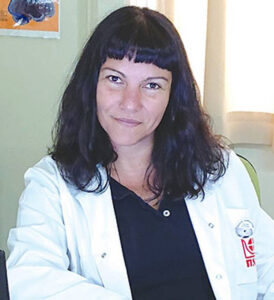
Kranioti Elena
Associate Professor of Forensic Medicine
Medical School, University of Crete, P.C. 70013 Heraklion, Crete
She is the Director of the English PG Programme “Forensic Medicine, Anthropology and Imaging” which runs since 2023, is unique of its kind and has attracted a great number of students from several countries. Elena has successfully supervised >120 postgraduate theses, two Masters of Research (MScR), and 15 doctoral degrees (main supervisor in 13) of which 11 have been successfully completed.
She is the author of more than 100 English-language publications on Forensic Medicine, Forensic Anthropology, Forensic Imaging, Bone Histology and Biology in international journals. She is the founding member of the Hellenic Society of Medical Forensics and Forensic Sciences, one of the representatives of Greece at the International Academy of Forensic Medicine and member of the board of directors of the Forensic Anthropology Society Europe.
2017-Certificate of Advance studies in Forensic Radiology and Virtopsy: Department of Forensic Medicine, University of Zurich
2009-Ph.D (with distinction): Sex estimation based on digital radiographs of the skeleton. Medical School, University of Crete, Greece
2003-MD: Medical School, University of Crete, Greece
1. Medical Imaging Analysis in the Investigation of death
2. Development of innovative virtual methods in Forensic Anthropology
3. Forensic trauma analysis
4. Radiomics
5. Bone histomorphometry
6. Skeletal growth and development
7. Interpersonal violence in past populations.
8. Bone biomechanics
9. Standards for biological profiling in modern populations
https://scholar.google.com/citations?user=cZbjFQ8AAAAJ&hl=en
and in Pubmed:
https://pubmed.ncbi.nlm.nih.gov/?term=elena+kranioti&sort=date&sort_order=desc
Hellenic Society of Forensic Medicine and Forensic Sciences (Elected Board Member 2022
2014)
International Academy of Legal Medicine (IALM)-National representatine
Forensic Anthropology Society Europe (FASE)-Board member
Medical Association Heraklion (ISH)
Laboratories
1.To aid the investigative authorities falling under the local Court of Appeal, as well as authorities based at other prefectures, in daily forensic casework
2.To train and educate undergraduate and postgraduate students of the Medical School of the University of Crete, as well as junior doctors, as part of their specialization in Forensic Medicine and Anthropology
3.To promote research in Forensic Medicine and other fields, including Forensic Anthropology, Post Mortem Imaging, Histopathology and Post Mortem Microscopy, often in collaboration with other research facilities (e.g. The National Centre for Scientific Research “Demokritos”, IMBB – FORTH).
Forensic investigations handled by FMU include:
1.Participation in crime/death scene investigations in collaboration with local authities in cases of suspicious or unexpected deaths
2. Application of post mortem imaging techniques in forensic cases
3. Performing autopsies in order to establish the cause and manner of death in violent, suspicious and sudden deaths
4. Body fluid and organ tissue samping
5. Preparation and microscopical examination of tissue samples
6. Identification of unkown bodies using anthropological and other methods
7. Examination of skeletal remains and single bones using anthropological and other methods
8.Implementation of forensic methodology in the investigation of death in clinical cases or in the investigation of hospital deaths
FMU has been conformed with the No. R(99) 3 recommendation by the Council of Europe regarding the investigation of forensic cases and the composing of official forensic reports.
Link: https://forensic.med.uoc.gr/index_en.jsp